"Bashert" by Conrad Singer            Chapter 7 A Commitment to Spain

seven

A COMMITMENT TO SPAIN.

   Through the introduction of my blind Yugoslav friend, I decided to join the Spanish Republican Army. I returned to my ship to collect my belongings and refused orders to carry out any more work. The captain ordered my arrest. I turned on my heels and made my escape. Jumping from the deck, on to the quayside, half dressed and running as fast as I could, I made for the headquarters of my new regiment. There, I asked for the assistance of two armed militiamen, who accompanied me back to the Verbormilia. I was therefore able to collect my belongings.
  

   At that time, Barcelona was an exciting place to be. Anarchists, communists, Catalan nationalists and all the other groups were fronting demonstrations of support for the Republican Cause. Lorries carrying young boys and girls were decked out with the colours of their factions and singing their individual anthems. 

   After a day spent in the barracks, sleeping rough and with hardly any food, we were sent to the front at Aragon. A long convoy of open goods wagons took the volunteers out of the railway station. There followed a long and slow journey to Alcaniz. We stopped in open country, to be issued with our only food for the journey, a loaf of bread and a tin of sardines.

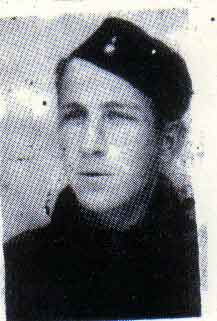
Spanish Republican Army
1937, aged 25

    We embarked in lorries for Utrillias; the next stage of our adventure was to take place in this mining village, where the regiment had its headquarters. It was singing all the way. I picked up the words of many revolutionary songs. We saluted the town of Montalba with:
             “  Here’s to you, my beloved Montalba
                Please forgive me
                For, I’m drunk from ale
                Because of a sad affair. “  

   Later, all the columns of the militia were disbanded and properly integrated in to the army. This was a sensible measure, since the militiamen were undisciplined and given to acting on impulse.

   After a few days, we moved out to an isolated village in the mountains, called Estercuel. This was spread around an old Moorish castle. I was immediately made a sergeant due to my military service in Romania.

   Sometimes, I would accompany my comrades on a journey to a huge convent, a few miles in to the mountains. In the cellars were huge wooden casks containing some of the finest claret I was ever to taste. The antagonism of the people towards the Catholic Church was all too obvious, from the devastation inside the building. This was a fitting response from the local population. They had suffered untold poverty, whilst the Church and its patrons lived in the height of luxury. The village was fully anarchist, in that everything the community owned was shared. They had their own printed money and the village was self-governing.

   At harvest time the whole village would leave their homes before sunrise. It was a beautiful sight to watch the columns, moving slowly up the mountainside and to hear them singing their folksongs such as “and let us Scale the Walls”, intermingled with anarchist marches.

   Sometimes, I would wander around Alcaniz, a nearby town and perhaps go and see a show, with singers from the provinces. It was there that I saw the famous blind singer, Nina La Puebla and heard her inspiring song “The Country People of Andalusia”.

   At last, the order came through for us to leave. We were taken by lorry, approximately fifteen miles, to another village, called Castillo de Cabra. There, we were issued with rifles and ammunition. During the evening, we found out that the cellar of the village tavern had been left with a good supply of champagne. The drinking went on all night with the soldiers not bothering to uncork each bottle and preferring to smash each neck on a stone.

   The next day, the troops were given summary drill with the newly issued rifles and were taken to the front at Belchiti, not far from Saragossa. Our regiments were held in reserve, behind the front line, where the assault on the enemy had started, the previous day. We made advances and were able to occupy the nearest village. A few of us rested in a barn, on the outskirts. We sat on the floor. Appetizing food was set out in front of us. Scarcely had we enjoyed a mouthful, when the whistle of falling bombs and explosions threw us all full length. Tremors shook the barn and the resulting dust covered our food. When the incident was over, we rushed outside and found two bomb craters no further that ten yards away with many other craters scattered around the village.  We were lucky.

Home      Contents

 Previous       Next